Qigong Practice for Modern Life
Recently, I had a direct reminder of why a modern approach to Qigong practice matters.
I was running a live online program, a simple, consistent 30-minute morning Qigong practice. It was designed to help them reconnect, settle and start their day in a more grounded way.
On the first morning, I woke with a slight tingling in my sinuses. I brushed it off, assuming it would pass. By the second morning, it hadn’t. I had to cancel the session. I was too unwell to get out of bed, let alone hold space and guide others through practice.
It wasn’t part of the plan, but it made something very clear.
Understanding Classical Qigong practice
There are thousands of Classical and Traditional Qigong forms, each offering different ways of working with the body, mind and spirit through the process of Qi Cultivation. These practices have been refined over generations and passed down through direct transmission, preserving their depth and integrity.
Classical practice is often intricate and precise. Movements are deliberate, layered with intention and developed over time through repetition. It asks for presence, patience and consistency.
These forms don’t just involve movement. They include stretching, balance, strength and weight-bearing elements that can be physically demanding, especially when practiced in their full expression.
They also take time.
To move through a complete form sequence can take an hour, sometimes longer. And while there’s value in that, it doesn’t always translate into the rhythm of modern life.
Life now moves differently.
There’s more demand on our time, attention and energy. More variation in how we feel from one day to the next. Less space to step out for long, uninterrupted periods of practice.
And yet, the way Qigong is often taught hasn’t really shifted to meet that.
Qigong practice for modern life
By the third session of the series, I was back teaching.
In hindsight, it was a little ambitious. I had to shift my focus. There was no way I could practice methods aimed at building vitality. At that point, my body needed something else entirely. It needed support to recover.
That meant softening the approach. Reducing intensity. Letting the practice meet where I was, rather than trying to push through it.
This is where a contemporary approach to Qigong practice becomes necessary.
In modern life, we move through fluctuating states — illness, fatigue, pressure and limited time. Practice can’t be rigid within that. It has to respond.
Sometimes that means stepping away from longer, more demanding forms. Not because they lack value, but because they’re not appropriate in that moment.
A shorter Qigong practice, even 15 to 20 minutes, can be far more effective when it’s aligned with what your body actually needs.
A framework for Qigong practice
A contemporary approach to Qigong isn’t about replacing tradition. It’s about how you work with it.
Rather than relying on a single, fixed form sequence, you’re working within a framework. One that allows you to draw on different methods depending on what’s needed.
The essence of the practice remains the same. Precision, presence and the quality of connection are still central.
What changes is how it’s applied.
The structure becomes more flexible. The duration can shift. The intensity can be adjusted. You’re not locked into completing a full sequence in the same way every time you practice.
This is what makes consistent Qigong practice possible.
A focused 15-minute session in the morning. A longer practice when there’s more space. A softer approach when the body needs to recover.
This is how Qigong becomes part of daily life, rather than something that sits outside of it.
A contemporary approach still draws from the depth of Classical traditions, including systems like Tai Chi and Dao Yin.
But it’s not about collecting forms or mastering complexity. It’s about developing the ability to work with your body and your current state in a way that is steady, responsive and sustainable.
Experiencing and learning Qigong
People often come to Qigong because they want to feel better. They might be recovering from illness, navigating stress or simply recognising that something feels out of balance. There’s a pull to reconnect, to restore and to move differently.
How they enter the practice matters. When Qigong is taught through a clear and accessible approach, people can begin experiencing it from the very first session. They’re not trying to work everything out in their head or keep up with something that feels out of reach. They can step in, follow along and actually feel what the practice is doing. That’s not always the case in more traditional learning environments.
Classical Qigong has depth, but it also takes time to understand. For someone new, it can feel like a lot to take in at once. The detail, the structure, the pacing. It’s easy to end up thinking your way through the practice rather than experiencing it.
A more contemporary approach creates a different entry point. People can join a class, attend a retreat or step into a session and participate straight away. They engage through doing — through observation, repetition and direct experience. And that matters, especially when time and energy are limited.
When the practice is simple enough to access, but still grounded in quality, people start to notice changes. They feel the benefit. And from there, something begins to deepen.
A way into Qigong practice
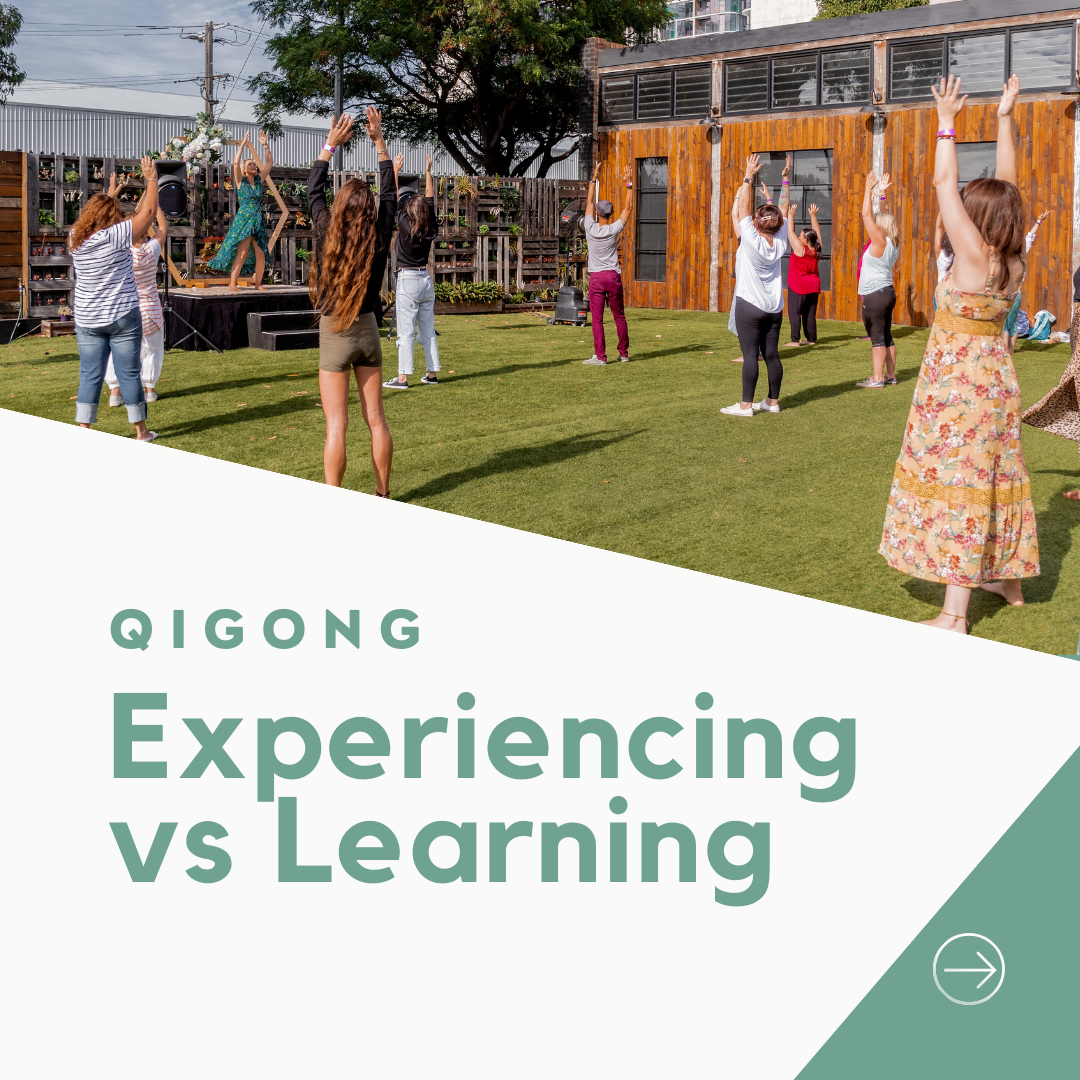
There’s a difference between experiencing Qigong and learning it.
Most people begin by experiencing the practice. They follow along, watching and doing at the same time. The structure is held for them, and they can drop into the movements without needing to fully understand them.
This is often where the first shift happens. The body softens. The breath changes. There’s a sense of calm or clarity that wasn’t there before. But at this stage, the practice is still external. They’re responding to what they see. Following cues. Moving with guidance.
Learning Qigong is different. It takes time, repetition and a willingness to stay with the practice beyond the initial experience. This is where establishing a regular relationship with practice becomes important. The movements become familiar. The sequence becomes known. There’s less reliance on watching and more capacity to move from within the practice itself.
This is where the practice begins to integrate. You’re no longer just following along. You can return to it on your own. You understand the structure well enough to practice without needing to copy or keep up with someone else.
And this is where the benefits deepen. Consistency becomes possible. The practice becomes something you carry with you, rather than something you access occasionally.
What begins as a simple, supportive practice can naturally lead into a stronger commitment. A curiosity to go further and explore more traditional forms with the time and attention they require.
This isn’t about replacing Classical Qigong.
There’s real depth there, and it deserves to be approached with the time, guidance and consistency it asks for. But not everyone is in a position to step into that straight away.
A way into Qigong practice
A contemporary approach creates a way in. It allows people to begin, to feel the practice and to experience its effects without needing to understand everything from the outset.
From there, the practice can deepen over time. For some, that means continuing with a simple, consistent approach that supports daily life. For others, it may lead into a more dedicated path of study, where the depth of Classical practice can be explored more fully.
Both are valid.
What matters is that the practice is something you can return to. Something that meets you where you are, while still offering the potential to deepen.
This is how Qigong becomes more than something you try. It becomes part of how you live.
If you're interested in exploring how Qigong can meet modern life without losing its depth, I share new writing and reflections by email.