What Does It Mean to Master Qigong?

Qigong is actually pretty simple. Stand. Move. Breathe. Be. So why can it be really challenging to develop a Qigong practice?
It’s because doing Qigong and developing the skill of Qigong are two different things.
Gong translates to skill. It's something that develops through practice, attention, repetition and time.
The Skill Behind the Practice.
You can learn a form quite quickly. You can watch someone and copy what they do. You can remember the sequence and become reasonably proficient at expressing the movements.
That doesn't necessarily mean you've developed much Qigong skill.
That's because Qigong is an energy skill.
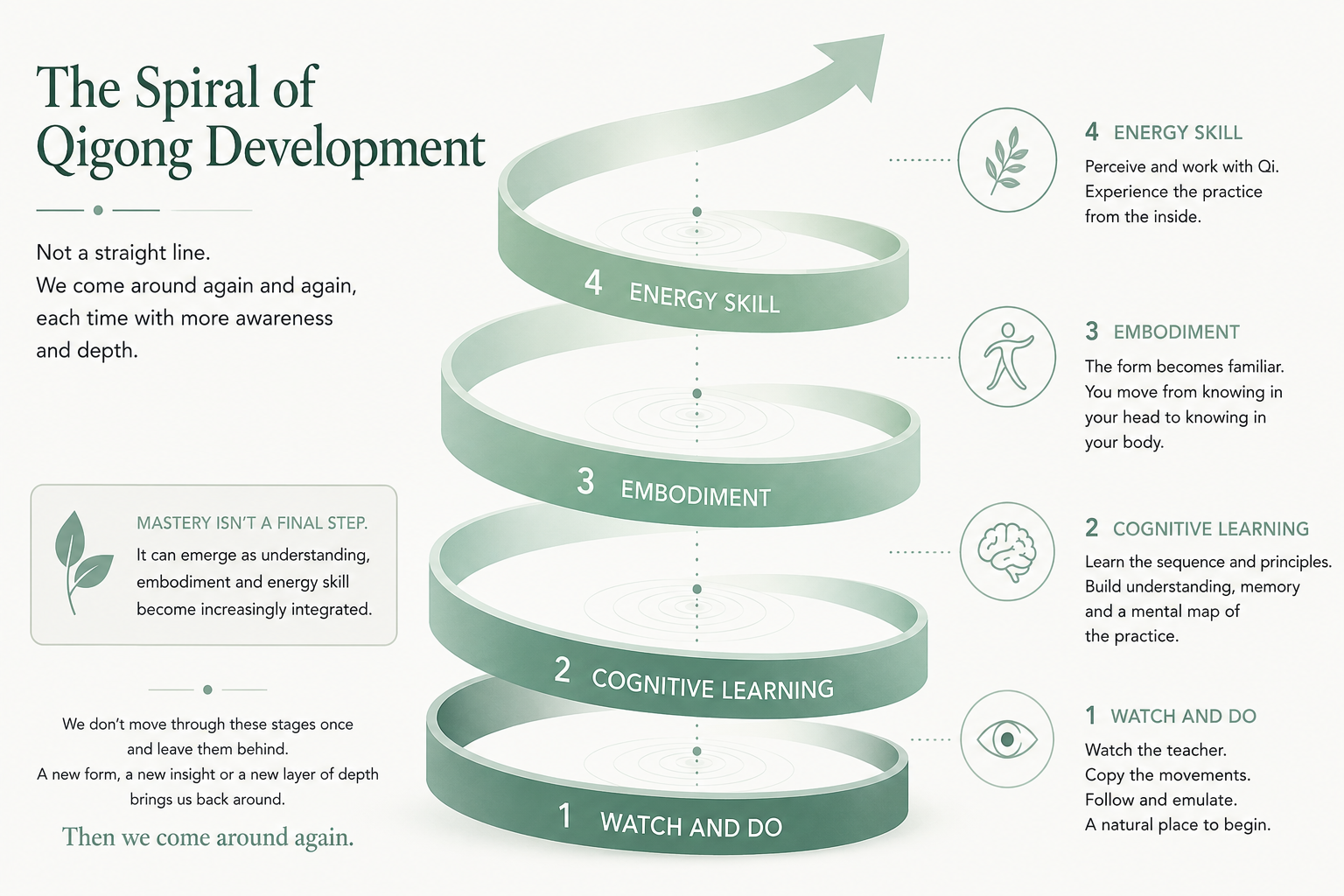
Developing that skill takes time. There are different aspects to learning Qigong — watching and doing, cognitive learning, embodiment and developing the ability to perceive and work with energy.
And it doesn't happen in a straight line. We move between these different aspects of practice, coming back around again and again. Each time we revisit them, something can deepen.
Watch and Do
When we first start practising Qigong, we're often watching someone else and doing what they do. We copy the movements. We follow the teacher's rhythm. We try to emulate what we see from the teacher and remember what comes next.
This is the Watch and Do phase, and it's a completely natural place to begin. It's how most of us learn physical skills. We might have a beautiful experience during a class and feel relaxed, grounded or even deeply moved afterwards.
At this stage, we're ultimately following someone else's expression of the practice. This is one of the reasons the NLQ Online Studio can be a great place to start. You can watch, follow along and gradually become familiar with the movements and the rhythm of practice.
That's not a problem. For some people, that's all they want from Qigong. This is also often the point where people stop practising. The initial novelty has worn off, the experience isn't always as immediate, and developing a deeper relationship with the practice requires a little more commitment.
But if we want to develop Qigong as a skill, there's more to explore.
Cognitive Learning
Once we move beyond simply watching and doing, we start to actually learn the practice.
We begin to give attention to the details. We learn the sequence, the principles behind the movements, how to coordinate the body and breath, what we're meant to be giving attention to and why we're doing what we're doing.
There's a lot happening here. We're using memory, concentration, attention and focus, and we're beginning to build a mental map of the practice. At this stage, a lot of our skill is still cognitive. We understand what we're doing, but understanding isn't the same as embodying it.
This is where having a regular relationship with practice becomes important. It's very difficult to develop familiarity with something we only return to occasionally. We need repetition. We need time with the practice. We need to come back to it often enough that it starts to become familiar rather than something we're continually having to relearn.
Establishing a regular practice gives us that opportunity. It doesn't have to be elaborate or look the same every day. It's about creating enough of a relationship with the practice that we keep returning to it.
Consistency doesn't have to mean doing the exact same thing every day. The practice can change. We can adapt it to what's happening in our lives. What matters is that we keep returning.
Over time, what we initially had to consciously remember becomes increasingly familiar.
Embodiment
At some point, something starts to change. The form becomes familiar. You're no longer having to consciously remember every part of the sequence or think about what comes next. The movement starts to become something you know through your body rather than something you have to think your way through.
This is embodiment.
It's not necessarily about making the movement look better or more polished. It's about becoming familiar enough with the form that you no longer have to use so much attention organising the movement.
Something has shifted. The practice starts to become yours. This creates more space for something else.
Energy Skill
This is where Qigong starts to become real. When you're not using all your attention to remember what comes next, you can start to give more attention to what you're actually experiencing.
You might notice changes in sensation, temperature, pressure, movement, density or other subtle information. You begin to recognise different qualities of energy and, over time, you become more familiar with what the spectrum of Qi actually feels like.
And you don't need an elaborate form to do this. In fact, simplicity often offers more in terms of being able to feel different frequencies of energy.
You can develop sensitivity to Qi through standing, through a single movement or through a very simple practice. You can begin to perceive energy before you've developed much form knowledge at all.
This is an important distinction. Learning a form and developing energy skill are related, but they're not the same thing. As the form becomes more embodied, though, your relationship with energy can change. You're able to move, breathe, give attention and perceive energy at the same time.
You start to experience the form from the inside.
The Spiral of Practice
We don't move through these aspects of practice once and then leave them behind. We come back around again and again.
A new form might bring us back to Watch and Do. We watch, we copy, we learn. Then we give it our attention, begin to understand it and gradually embody it. As the form becomes more familiar, we have more space to perceive. We might notice something about the energy that we didn't notice before, or experience a familiar movement in a completely different way.
Then we come around again.
This is why development in Qigong isn't linear. We can develop sensitivity to Qi before we've learnt many forms. We can return to cognitive learning after years of practice because we're encountering something new. We can embody something we've done hundreds of times at a deeper level.
We're not going backwards. We're coming around again with more awareness and experience.
This is where mastery sits.
Mastery isn't another step that we eventually arrive at. It's something that can emerge as our understanding, embodiment and energy skill become increasingly integrated.
There is always another layer to discover.
These days, my primary practice of Qigong is formlessness. For me, that means sitting in frequency meditation and working directly with the energy rather than expressing it through a physical form. Yang Sheng Fa has become an equally important part of my practice, in how I live and care for my life.
That's where the spiral has taken me.
If you're interested in exploring what happens as practice moves from something we do to something we embody, I share new writing and reflections by email.