The Eight Extraordinary Vessels in Qigong
If you’ve practised Qigong for some time, you may have noticed there is a difference between circulating Qi and feeling energetically coherent — settled, contained, gathered within yourself.
One of the most direct ways practitioners begin developing this sense of energetic containment is through standing practice, particularly Zhan Zhuang (Standing Qigong).
The twelve primary meridians regulate daily function and vitality. Beneath them lies a quieter structure, one that shapes how we stabilise, contain and mature over time.
The Eight Extraordinary Vessels.
Why the Eight Extraordinary Vessels Matter in Qigong Practice
The Eight Extraordinary Vessels are often described as reservoirs or ancestral channels. Collectively, they are sometimes referred to as the congenital energy body, the subtle architecture shaping our pulses, elemental flows and the deeper patterns that organise both body and psyche. Unlike the twelve primary meridians, which lie closer to the surface of the skin, most of these vessels sit deep within the body.
With the exception of the Governing Vessel (Du Mai) and the Conception Vessel (Ren Mai), they regulate quietly beneath ordinary awareness. They are less connected to daily circulation and function; instead, they hold the blueprint of your energy system.
This is why practice can feel very different once this layer begins to consolidate. Circulation alone no longer feels sufficient. There is a deeper call toward consolidation.
In Daoist health philosophy, these vessels are intimately connected with Jing — our constitutional essence. Jing forms the dense material foundation of growth, reproduction and long-term vitality. It carries the imprint of ancestry, genetics and inherited patterning. It also holds the deep memory of how life has unfolded through us, particularly during our time in utero and through the earliest phases of development.
The Extraordinary Vessels step in when the system becomes depleted — they compensate. When the system becomes excessive or scattered, they help reorganise and contain it. They redistribute what is essential and protect structural integrity. This is why they are sometimes described as the congenital cage, not as something restrictive, but as the subtle framework that keeps the whole coherent.
Without this deeper containment, practice can remain circulatory but not consolidating. Qi moves. Sensation arises. It does not root. Breathing reflects this as well — when the system is scattered the breath becomes unsettled, but as the body gathers, breathing in Qigong naturally settles and deepens.
While the twelve primary meridians are closely linked to the Zang Fu organs, the Eight Extraordinary Vessels relate to what classical texts call the Curious Organs — the brain, uterus, blood vessels, gallbladder, bones and bone marrow. They are described as curious because they do not follow the usual organ–meridian rules. They are multifunctional and subtle, deeply involved in perception, memory and consciousness. They also connect with the body’s orifices, influencing how we take in the world, how we perceive it and how we respond.
The Vessels That Shape Our Becoming
This is where subtle anatomy meets lived experience.
Each of these vessels reflects aspects of the psyche. They influence how we process memory, how we organise experience and how we hold ourselves under pressure. It shows up in the way we return to centre — or fail to — in our lives.
When this layer begins to strengthen, something subtle shifts. Emotional reactions may still arise, but they do not unsettle the body in the same way. The spine feels more supported from within. Qi begins to gather more naturally in the lower abdomen rather than dispersing upward, reflecting the way Qi develops and is stored within the body through consistent practice.
Three of the Eight Extraordinary Vessels are especially significant in prenatal and early postnatal development: the Chong Mai, Ren Mai and Du Mai. The Chong Mai, often called the Sea of Blood or Thrusting Vessel, is said to emerge first after conception. It carries the energetic core of genetic inheritance and reflects that original movement from unity into individual existence. The Ren Mai and Du Mai form the central yin–yang axis of the body — the Ren flowing along the front, the Du along the back — regulating the balance between inner and outer forces. In women, the Conception Vessel flows directly to the uterus, a direct line to life force itself, carrying echoes of ancestry and creation.
These channels do not simply hold Qi. They shape development. They shape resilience. They shape how we inhabit ourselves.
The Inner Axis of Heaven, Earth and Human
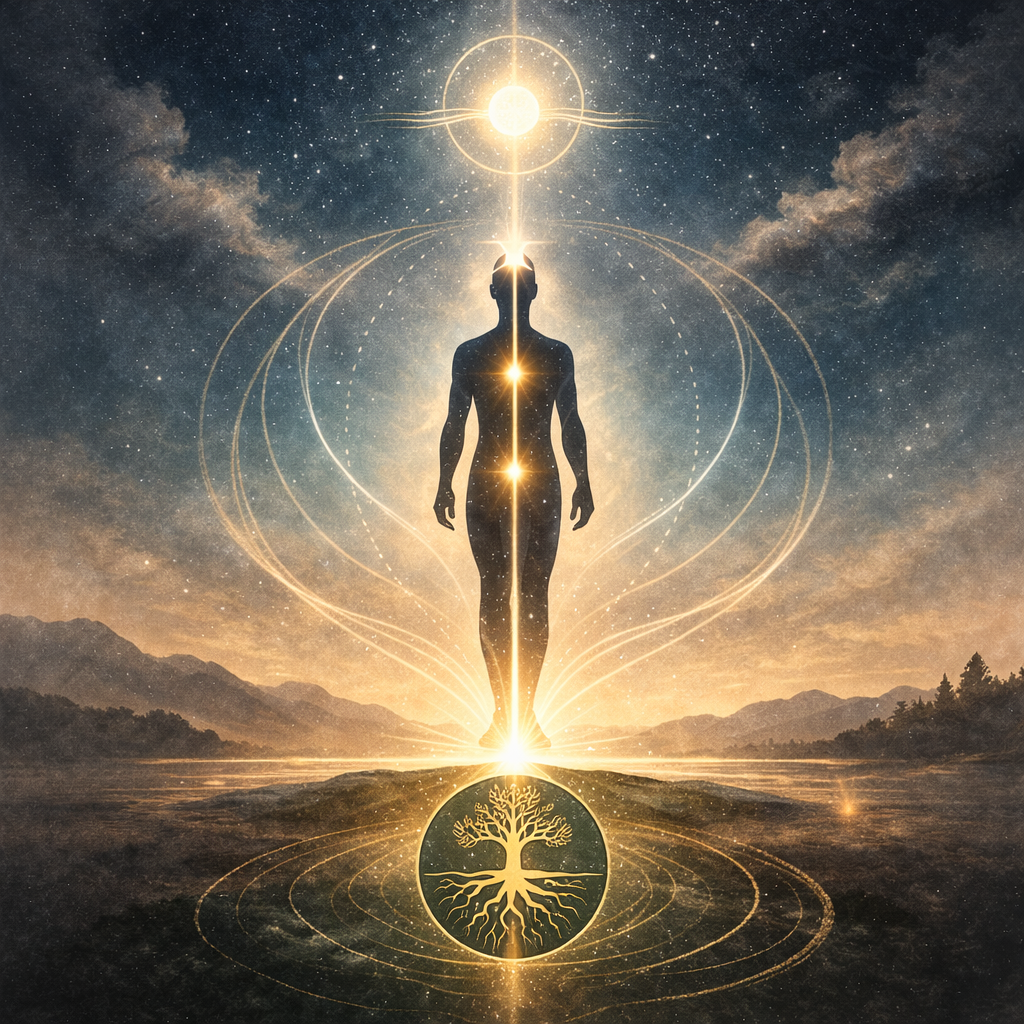
In addition to the Eight Extraordinary Vessels, there is also the Zhong Mai — the Central Channel, sometimes called the Taiji Pole or Grand Thoroughfare. Some traditions equate it with the Chong Mai, while others distinguish it. In the context of practice and energetic development, I view the Central Channel as distinct. The Grand Thoroughfare runs along the midline from Huiyin (CV 1) to Baihui (GV 20), extending beyond the physical body to connect upward through the transpersonal point and downward into the earth beneath the feet. It forms the inner axis between heaven and earth and relates to the broader toroidal field of the subtle bodies.
On a psycho-spiritual level, this channel holds our unique blueprint, intergenerational patterns, cellular memory and karmic imprinting. It reflects the unfolding of Xing, our true nature, and the gradual maturation of the Self.
Standing at the Threshold of Inner Work
When I first encountered Nei Gong, I rushed toward the internal practices. There was excitement — a sense that I had found something profound, and I wanted to access the deepest layers immediately. I was far more interested in the internal alchemical work than the inner refinement that supports it.
It took time, and humility, to realise that what I truly needed was the Shen Gong stream. It is honestly the most challenging stream to engage in.
Not because it is dramatic. But because it asks for consistency. For containment. For self responsibility, and self-acceptance.
In Shen Gong practice, we work primarily with the Eight Extraordinary Vessels and the Heartmind. There is still form practice, the body remains essential, but the emphasis shifts toward stillness, contemplation, self-inquiry and subtle refinement. This stream of practice is not about creating sensation or chasing energetic flow. It is about focusing the mind, forging the Dantian and cultivating emotional containment.
The Extraordinary Vessels respond to structure, alignment and consistency — qualities traditionally cultivated through practices such as Standing Qigong. They respond when the system is gathered rather than scattered. While general Qigong nourishes the Vital body beautifully, Shen Gong and Nei Dan refine something quieter and more profound. Fragmentation lessens. Coherence strengthens. The deeper channels begin to function as a well, drawing us toward a more harmonious centre.
Not everyone feels called to this layer of practice. And not everyone needs to be. But if you sense that circulation alone is no longer enough, if you feel the quiet pull toward deep inner skill rather than more movement — then you may already be standing at the threshold of this work.
Work with the Eight Extraordinary Vessels does not sit separate from foundational Qigong. It emerges from it. Over time, that emergence reshapes not only practice, but the way we meet ourselves and the world.
If you sense there is more to practice than movement and circulation, I share new writing and reflections on Qigong, cultivation and inner development by email.