
Zhan Zhuang: Standing Qigong Practice That Changes Everything
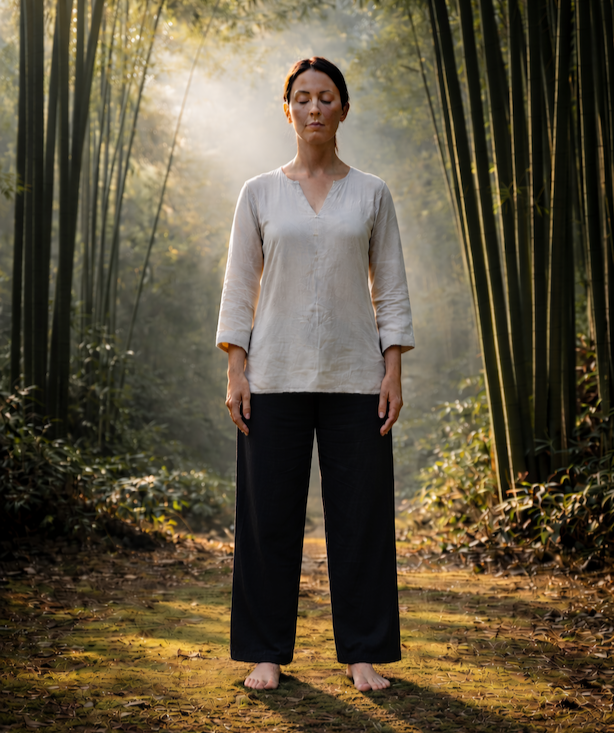
Most people think Qigong is a moving meditation. It can certainly be perceived that way. Form expression is often beautiful, and flow elicited from the Qigong state can feel incredible. The circulation of fluids and energy and the opening of neural pathways feels tangible. There is feedback, sensation and a sense of progress.
Standing practice is different.
There is nowhere to go, no choreography to rely on, no distraction of staying on track with a sequence, no momentum carrying you forward. There is just you, your structure and your mind. And that is exactly why it matters.
Zhan Zhuang is a traditional standing practice within Qigong, often translated as “standing like a tree”. The posture itself couldn’t be simpler, yet through standing the body begins to reorganise around alignment, breath and the movement of Qi. What appears quiet from the outside is in fact one of the most foundational ways of developing internal strength, stability and coherence within Qigong practice.
What Standing Reveals
When I first discovered Qigong and undertook my initial trainings, I didn’t understand standing at all. It wasn’t emphasised in the way I now know it needs to be. I wasn’t really taught how to stand, nor did I grasp its importance. It’s something I’ve had to develop and deepen into over time through my own practice and study. Standing often reveals what movement allows us to bypass.
It shows you whether your system is organised or scattered. It reveals where you leak, where you grip and where you compensate. It exposes the difference between holding tension and holding structure that can support expansive energy. When we stand correctly, not rigid, not collapsed — something begins to consolidate. There is alignment in the musculoskeletal system, the breath begins to regulate naturally, the nervous system softens and the mind, if we train it, begins to focus and settle. This is one of the reasons breathing in Qigong is not usually trained as a technique, but emerges as the body becomes more organised through practice.
Standing is known traditionally as Zhan Zhuang. It is one of the most foundational, and most misunderstood practices within Qigong. On the surface it looks like stillness; internally it is structural reorganisation.
This is developmental work.
Standing still may appear passive or simplistic, yet internally there is a lot happening. Developing posture, alignment and the ability to release unnecessary tension becomes an important part of allowing these deeper processes to unfold.
Standing practice is a journey in itself, and you will often feel all kinds of sensations as Qi begins to reorganise. The body may tremble, the feet may burn, the calves may tighten, nausea may rise and tears may flow. The mind will search for distraction. Everything in you may want to escape. And if you stay, without forcing and with an inner friendliness, something begins to shift. The sensations subside, the system gathers and you feel quietly held from within.
Building the Capacity to Hold Qi
Over time, standing strengthens the inner axis. It teaches the body how to root without force and how to rise without strain. It builds containment. Emotional reactivity becomes less frenetic. Qi no longer rushes upward as easily. There is more coherence under pressure. Movement can generate flow; standing builds the capacity to hold it.
Without this foundation, Qigong practice can remain circulatory but not consolidating. Movement can mask postural weakness, and flow can distract from depth and real transformation. Without containment, increased Qi does not mature the system, it agitates it. Standing reveals the truth. It asks for consistency, patience and self-responsibility.
Where Development Actually Begins
In Daoist cultivation, the forging of the Dantian and the protection of Jing are achieved through repetition and presence, through allowing the system to organise itself around a stable centre. This is not built in weeks. It is built in months and years of consistent practice. Many students express interest in Dantian Gong, in building the capacity of the Dantian, the elixir field — yet few are willing to show up and stand, often through sustained Zhan Zhuang practice, at the level required for the Dantian to actually develop.
Many practitioners avoid standing. It is simple, but not easy. It requires us to meet ourselves without distraction. And yet, if you stay with it, an ease emerges. The body begins to hold itself differently, the mind becomes more focused and the deeper vessels respond. From here, a student edges away from Qigong understood purely as moving meditation and into the streams of Shen Gong, Nei Gong and Nei Dan — not by adding more form, but by strengthening the foundation that holds it. Standing practice does not replace movement; it gives movement integrity. And over time, that integrity changes everything.
At some point, every serious practitioner meets this doorway. If you feel that shift happening in your own practice, or you sense that this depth is what you’re ready for, then standing may be the doorway you’ve been avoiding, or quietly circling.
If you're interested in exploring what lies beneath the forms of Qigong and how practice becomes a path of deeper cultivation, I share new writing and reflections by email.